

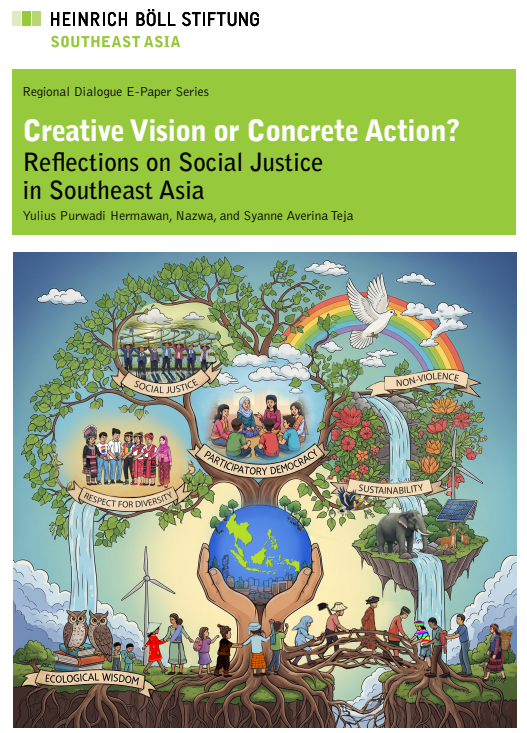
In a newly released E-Paper titled Creative Vision or Concrete Action? Reflections on Social Justice in Southeast Asia, the authors Yulius Purwadi Hermawan, Nazwa, and Syanne Averina Teja. The paper critically examines the longstanding tension between ASEAN’s normative commitments to social and environmental justice and the limited extent to which these commitments have translated into concrete outcomes across Southeast Asia. While social justice has been constitutionally embedded in many Southeast Asian states since independence, persistent inequalities continue to shape the region’s social, economic, and political landscape.
The E-Paper highlights that ASEAN has invested significant effort in constructing a regional normative architecture for justice. Foundational documents, including the 1967 Bangkok Declaration, successive ASEAN Conventions, the ASEAN Charter, the ASEAN Human Rights Declaration, and the ASEAN Socio-Cultural Community (ASCC) Blueprint 2025, articulate strong commitments to equality, poverty reduction, and inclusive development. In parallel, environmental justice has gained increasing prominence through regional instruments such as the 1985 ASEAN Conservation Agreement, the 2007 Declaration on Environmental Sustainability, and the recently adopted 2025 ASEAN Declaration on Environmental Rights. Collectively, these frameworks signal ASEAN’s aspiration to ensure equal access to opportunities, environmental protection, public participation, and strengthened rights across the region.
Despite this extensive normative framework, the authors demonstrate that significant gaps remain between vision and reality. Drawing on comparative data presented in the E-Paper, including GDP per capita disparities, poverty levels, literacy rates, and gender gap indicators, the study reveals deep development disparities among ASEAN member states. Cambodia, Laos, and Myanmar continue to face high poverty and low literacy rates, while income inequality remains pronounced in countries such as Indonesia, Cambodia, and Laos. Gender inequality is also evident, with women still underrepresented in parliamentary and decision-making spaces across much of Southeast Asia. These patterns underscore the persistence of structural barriers that undermine ASEAN’s commitment to shared prosperity and social justice.
The paper further argues that environmental justice faces parallel challenges. Although ASEAN has strengthened its environmental commitments through the new Declaration on Environmental Rights, implementation remains weak. Limited enforcement capacity, restricted access to information, insufficient public participation, and ongoing threats to environmental human rights defenders continue to constrain progress. Persistent issues such as transboundary haze, deforestation, inadequate environmental governance, and the marginalization of Indigenous rights illustrate how environmental justice has yet to be fully integrated into ASEAN’s broader social justice agenda, despite its critical relevance to climate risks, displacement, and resource-related conflicts.
In conclusion, the authors contend that ASEAN’s strength in vision-building must be matched by institutional reform and tangible action. The E-Paper recommends establishing a Special Commission on Social Justice, strengthening collaboration with development partners, creating a regional civil society hub, and accelerating the implementation of the ASEAN Declaration on Environmental Rights. Only through enhanced institutional capacity, accountability mechanisms, and inclusive participation can ASEAN bridge the widening gap between rhetoric and reality, and move closer to realizing a genuinely people-centered regional community.
The full E-Paper is available through the link provided: https://th.boell.org/en/2025/12/17/creative-vision-or-concrete-action-reflections-social-justice-southeast-asia